
Protect Amazon SP-API Applications with Incident Response
Incident response measures to protect Amazon SP-API applications.
This guide outlines guidance on what constitutes an incident response plan and the mechanisms required to handle an incident. A well-documented incident response plan helps you identify, detect, and respond to risk management failures quickly. The plan should be regularly reviewed and revised to facilitate immediate incident handling and incorporate lessons learned.
Amazon Data Protection Policy (DPP) requirements
The Amazon Data Protection Policy contains two categories related to security requirements:
- Section 1. General Security Requirements, which includes requirements for all Solution providers building SP-API applications.
- Section 2. Additional Security Requirements for Personally Identifiable Information (PII), which includes additional requirements for Solutions providers performing restricted operations on SP-API that involve personally identifiable information (PII).
To comply with the Incident response requirements in the DPP, Solution providers must:
- Maintain thorough incident response plans approved by senior management and reviewed every six months and updated after major infrastructure changes or lessons learned.
- Include all standard incident response phases (preparation, identification, containment, eradication, recovery, lessons learned) with specific procedures for different incident types.
- Establish annual risk assessment and management processes reviewed by senior management and document roles, responsibilities, and decision-making authority for all team members.
- Designate an Incident Management Point of Contact (IMPOC) and maintain current IMPOC contact details.
- Maintain updated contact lists with clear internal escalation paths and notify Amazon at [email protected] within 24 hours of detecting security incidents.
- Establish procedures for notifying government agencies as required by law and create customer communication protocols for incident status updates.
Incident response
Solution providers should understand security incident response (IR) processes, and security staff should understand how to respond to security issues. Solution providers without a dedicated security team should ensure a portion of the organization is sufficiently trained and equipped with tools to perform such activities. Alternatively, they should consider establishing a dedicated security team. Solution providers who wish to build a mature security team should consider this best practice: integrate the flow of security events and findings into a notification and workflow system. Such systems include ticketing systems, a known/technical issue system, or other security information and event management (SIEM) system.
Solution providers should start small, develop runbooks, leverage functional capabilities, and create a library of incident response mechanisms to iterate from and improve upon. This should include teams that are not involved with security, including the legal department. This cross-functional approach helps Solution providers understand how IR impacts business objectives.
Solution providers should consider using industry guidelines such as the Incident Response Recommendations and Considerations for Cybersecurity Risk Management, A CSF 2.0 Community Profile. This NIST guide includes a checklist of major incident response steps that Solution providers can use as a template when developing their plan. They may develop a specific plan to reflect the organization's functions, objectives, risks, and mitigating actions. Each of these is dependent upon the size and complexity of the organization and its systems.
Throughout this guide, we refer to the United States' National Institute of Standards and Technology's (NIST) Security and Privacy Controls for Information Systems and Organizations (Special Publication 800-53 Revision 5), commonly referred to as NIST 800-53 as a reference. This developing framework provides flexible controls to protect organizations from security and privacy threats. Solution providers should consider using this framework to implement and strengthen their organizational controls.
Foundation of incident response
Incident response plans, often referred to as procedures or runbooks, define the steps to investigate and remediate an incident. Experience and education are vital to implementing an incident response program before handling a security event.
An event is any occurrence in a system or network, ranging from acceptable events (e.g., a known user logging into a computer) to an adverse event (e.g., an unknown user logging into a computer). Adverse events can escalate into incidents that violate computer security policies, acceptable use policies, or contractual requirements.
Solution providers who wish to use NIST 800-53 to establish an IR plan may examine section IR-8: Incident Response Plan. IR-8 details the necessary components in implementing an IR plan. Such components include:
-
Defining the resources and management support needed.
-
Reviewing and approving the plan at a defined cadence.
-
Designating responsibility for IR to appropriate personnel.
By implementing this control, Solution providers can achieve compliance with Amazon DPP requirements. This includes reviewing and verifying the plan every six months and informing Amazon within 24 hours of detecting any incidents.
Incident Management Point of Contact (IMPOC)
Solution providers must identify and designate an Incident Management Point of Contact (IMPOC) who can be reached in the event of any incident, such as a data leakage or security breach. The IMPOC serves as a readily available contact for Amazon to reach out to when security incidents are identified.
IMPOC requirements
Solution providers must ensure their designated IMPOC:
-
Is readily available and accessible for incident communications.
-
Has the authority and knowledge to coordinate incident response activities.
-
Can be contacted quickly in the event of data leakage or security breach events.
-
Maintains current contact information (name, email, and phone number) that is shared with Amazon.
The IMPOC designation is a critical component of the incident response framework and helps ensure timely communication and coordination when security incidents occur.
Security events
A well-defined incident response plan includes response mechanisms for different types of security events. Solution providers should consider using diagrams to map the relationship between threats and the appropriate response mechanisms. For example, the Johari Window, created in 1955 by Joseph Luft and Harrington Ingham, is a grid that consists of four quadrants, as depicted below:

Types of security events
The Johari Window provides a useful framework for Solution providers to assess and categorize organizational threats. For incident response purposes, the four quadrants represent: Obvious, Internally Known, Blind Spot, and Unknown threats. For each incident type, Solution providers should define response procedures to ensure adequate preparation. As Solution providers define those types, they should consider the threats relevant to both partners and suppliers. Include contact information and identify the point at which the tools and systems notify personnel within the organization. This is required to comply with service level agreements in regulatory and contractual obligations, including with Amazon.
Obvious
Obvious threats are risks of which both Solution providers and their partners, such as Amazon, are aware. For example, malicious actors commonly employ Denial of Service (DoS) attacks against organizations. In a DoS attack, a malicious actor temporarily or indefinitely disrupts the application's availability. Solution providers should employ mechanisms to protect services from intentional malicious interruption. Solution providers should consider defining minimally acceptable downtime recovery goals for DoS attacks.
Malicious actors commonly attempt to invade, and even control, organizations by intruding into their applications. Solution providers can mitigate intrusion attempts by implementing Intrusion Prevention Systems (IPS) and Intrusion Detection Systems (IDS). Each system examines network traffic flows to detect if an intruder is attempting to access the system. In the case of an IPS, the system prevents unauthorized users from entering. However, if an intrusion is successful, an IDS sends a notification to trigger a response.
Internally known
Internally known threats are those that the Solution providers are familiar with, but their partners (such as Amazon) are not. This includes internal expertise or institutional knowledge. For example, the development team may have established but undocumented practices for managing configuration changes, which creates risks. For example, the team:
-
Might not be confident that all changes are tested and approved.
-
Might not have rollback mechanisms in case code releases did not work as intended.
-
Might not scan for technical issues in new production releases.
Solution providers should consider these scenarios to mitigate internally known threats.
Additionally, insider risks, such as an employee's malicious or unintentional action, might harm the environment. Access management controls and data loss prevention mechanisms help prevent and detect such actions. Limiting unauthorized data access, both from internal and external entities, is a critical step in securing and protecting data. Solution providers should employ the principle of least privilege—granting only the access necessary for each person or program to complete their respective tasks. It is best practice to delete default access accounts and limit the use of shared accounts. If necessary, Solution providers should monitor shared accounts to validate that they are only used when necessary. Shared accounts should only be shared after the appropriate administrators approve their use. Solution providers may supplement these monitors with data loss prevention controls. This prevents inadvertent sharing of confidential or critical information with unauthorized parties. That information may even include encryption keys or application credentials (e.g., embedded in code and exposed in GitHub) that can bypass the controls.
Blind spot
Blind spots are risks that a partner is familiar with, but Solution providers are not. A partner with the right expertise can share that knowledge. Such risks may be Common Vulnerabilities and Exposures (CVEs) that affect applications without the owner's knowledge. Although Solution providers may know these risks exist, partners can recommend specific controls and solutions they have not considered. Additionally, a partner may be equipped to identify fine-tuned controls for mitigating risks in the internally known quadrant.
Other blind spots include the changing regulatory environment. The European Union's General Data Protection Regulation (GDPR) affects businesses worldwide, and similar regulations, such as the California Consumer Privacy Act (CCPA), are quickly arising. Such regulations can affect response mechanisms and notification methods.
Monitoring the external environment helps mitigate these risks. Specifically, the National Vulnerability Databases (NVDs) helps organizations understand the latest vulnerabilities and their risk scores. Such scores, led by the Common Vulnerability Scoring System (CVSS), enumerate a technical issue's severity, taking into account its complexity and impact. Solution providers should stay abreast of industry updates, regulatory changes, and contractual requirements. Requirements change frequently and may require Solution providers to improve internal processes to remain compliant. Solution providers should meet with partners regularly to understand blind spots and mitigate them. To improve their security posture, Solution providers may contact Amazon using the Amazon Services Support page.
Unknown
Unknown threats are risks which neither Solution providers nor their partners are familiar with. Implementing and reviewing monitoring mechanisms can identify indicators of security events.
Indicators of security events
Solution providers should investigate all security events to ensure that they do not develop into security incidents. Though not exhaustive, Solution providers should consider the following list of potential indicators of security events:
-
Logs and monitors. A sudden change in computing activity, as indicated by monitoring tools and logs, can indicate a security event.
-
Unusual billing activity. A sudden increase in billing activity can indicate a security event. This billing activity might arise from compute-intensive processes that an intruder might initiate, such as bitcoin mining.
-
Threat intelligence feeds. If your organization subscribes to a third-party threat intelligence feed, correlate that information with other logging and monitoring tools to identify potential indicators of events.
-
Data integrity. Data in a service or application returns unexpected values.
-
Data exposure. Sensitive data is exposed to unauthorized or unintended parties.
-
Lack of availability. An application or service cannot fulfill its functions.
-
Public-facing security contact mechanism. A well-known, well-publicized method of contacting the security team can inform Solution providers of an incident. Customers, the development team, or other staff might notice and report something unusual. Solution providers who work with the general public might need to develop a public-facing security contact mechanism, such as a contact email address or a web form.
-
System alerts. Internal systems may generate notifications that alert in case of unusual, malicious, or expensive activities. For example, Solution providers may create a notification for activities that occur outside of expected time frames.
-
Machine learning. Solution providers can leverage machine learning to identify complex anomalies for a specific organization or individual person. Solution providers can profile the normal characteristics of the networks, users, and systems to help identify unusual behaviors.
Define roles and responsibilities
Incident response skills and mechanisms are vital when handling new or large-scale events. Handling unclear security events requires cross-organizational discipline, decisive action, and the ability to deliver results.
Solution providers should work with stakeholders, legal counsel, and organizational leadership to identify goals in responding to an incident. Some common goals include containing and mitigating the issue, recovering the affected resources, preserving data for forensics, and attribution. Solution providers should consider these roles and responsibilities, and whether any third parties should be involved. All incident documentation, including incident descriptions, remediation actions, and associated corrective controls, must be made available to Amazon upon request.
List of security stakeholders:
-
Incident Management Point of Contact (IMPOC). The designated IMPOC serves as the primary contact for Amazon in the event of security incidents, data leakage, or security breaches. This individual must be readily available and have the authority to coordinate incident response activities across the organization.
-
Application owners. Solution providers might need to contact owners of impacted applications or resources because they are subject matter experts (SMEs) that can provide information and context. Application owners or SMEs might be required to act in situations where the environment is unfamiliar, has unanticipated complexity, or where the responders do not have access. SMEs should participate in incident response exercises and establish working relationships with the IR team.
-
Information security. The Information Security team is the primary contact point when an event or incident is identified. They can respond by investigating, remediating, and preventing incidents from occurring.
-
Legal. The Legal team provides guidance in understanding any legal impacts a security incident may have. This includes crafting communication for all affected parties, including contractors, service providers, customers, and regulatory authorities.
-
Chief, Business, and Information Security Officers. Information security leadership, including the Chief Information Security Officer (CISO) need to remain abreast of the Solution providers' security health. In coordination with the Information Security and Legal teams, the CISO leads the organization to prevent, detect, remediate, and communicate incident response in accordance with laws and best practices.
-
The rest of the organization. The overall organization should be aware of potential risks and appropriate reporting mechanisms. Information security awareness training can help the staff (technical and non-technical) prevent security events from occurring, identify indicators of incidents, and report potential incidents to the security team.
-
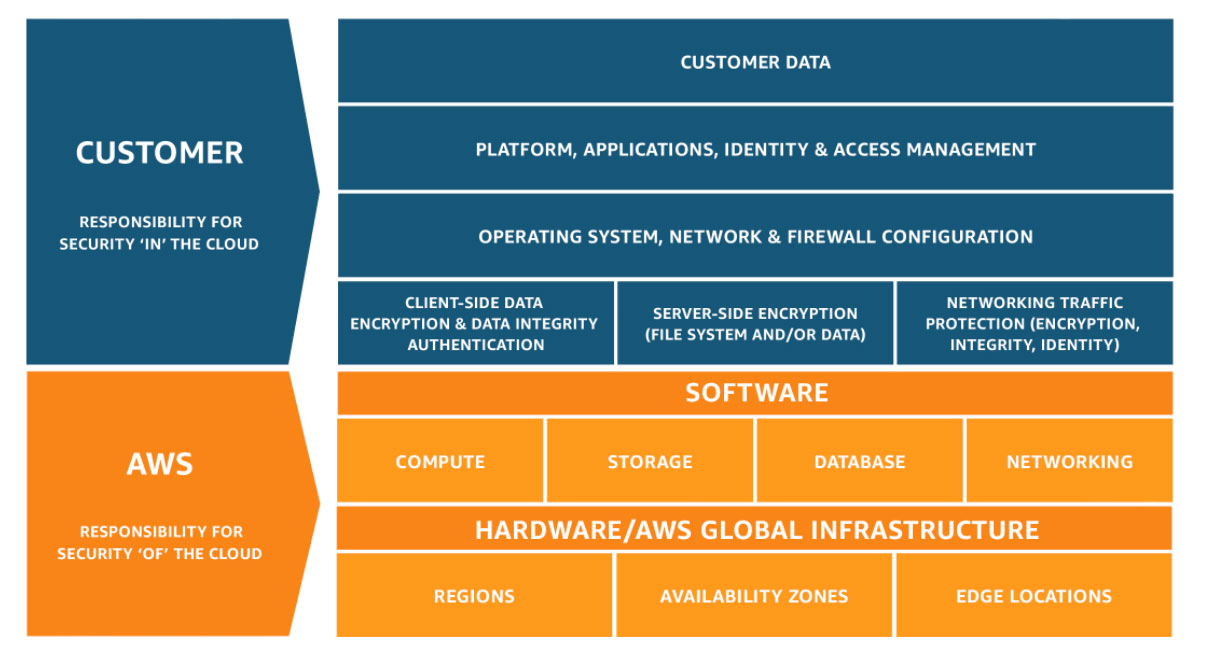
Third parties. Trusted partners can help in investigation and response, providing additional expertise and valuable scrutiny. Such partners include third parties who contractually require notification that an incident occurred. Specifically, Solution providers must inform Amazon at [email protected] within 24 hours of detecting any security incidents. Alternatively, service providers might specify in their terms and conditions which information security areas they are responsible for. Such providers or partners might include Cloud Service Providers (CSPs) who own a portion of the security responsibilities within the environment. The following figure shows a typical representation of the shared responsibility model as it applies to AWS. AWS owns the security OF the cloud, providing the highest levels of security possible. Their customers are responsible for the security of their resources in the cloud, keeping its content secure and compliant.
Notification and response
Solution providers should notify appropriate parties, such as Amazon, when an event occurs so they can respond in accordance with the processes. Otherwise, the event goes undetected and causes greater damage to the system.
Solution providers should implement monitoring systems that can automatically alert after an event has occurred. Common notification mechanisms include emails, ticketing systems, pagers, alarms, and short message service (SMS). Solution providers should have sufficient tools to respond to the incident in accordance with the response objectives.
Solution providers should implement response patterns when the event occurs. Documenting an incident is crucial. This preserves relevant information such as the incident description, remediation actions, and controls implemented to help prevent future recurrence. Per the Amazon DPP, Solution providers should document the incident, remediation actions, and corrective controls implemented to prevent recurrence. Additionally, creating documentation aids in escalating the issue to internal stakeholders, partners, and affected parties.
Solution providers using NIST 800-53 may refer to IR-4: Incident Handling. Effective incident response means handling an incident in accordance with best practices and internal plans. Incident handling and incident response plans are interconnected. Each supports the other as Solution providers strengthen their incident handling and response capabilities. Control IR-4 supports this, and following each portion of the control helps the Solution provider to comply with the Amazon DPP. While not required, we recommend Solution providers consider implementing the control enhancements in this domain. These enhancements help Solution providers become well equipped to respond to different types of incidents and certify the health and success of their operations.
NIST control IR-6: Incident Reporting helps define the personnel in an escalation path. This is the chain of people that should remain informed should an incident take place. Solution providers should define an escalation path to keep critical stakeholders and legal counsel informed. This enables them to assist the security team in taking action. Relevant stakeholders remain informed of the incident, its effects, and its status, all of which are necessary in the event that the Solution providers are legally or contractually obligated to notify an outside party. Solution providers should understand the legal and contractual requirements for reporting an incident, to whom, and when. Similarly, Solution providers should develop objectives to abide by those requirements.
Solution providers should validate that the escalation path and notification procedures include all parties with a legal or contractual right to know. For example, GDPR mandates that data controllers should notify the relevant supervisory authority within 72 hours after verifying that certain types of personal data breaches have occurred. Similarly, the Amazon Data Protection Policy requires that Solution providers inform Amazon through email to [email protected] within 24 hours of detecting an incident.
Preserve evidence
Solution providers should verify that they are collecting, storing, and protecting logs that capture all critical actions within the environment. At minimum, these logs should contain:
-
The success or failure of the event.
-
The date and time.
-
Access attempts.
-
Data changes.
-
System errors.
Solution providers with access to Amazon information should ensure that logs do not contain Personally Identifiable Information. Logs should be retained for reference in the case of a security incident. For a list of logging requirements, refer to "Logging and Monitoring" in the Data Protection Policy.
Solution providers should protect logs from accidental or intentional deletions by storing them in a secure location with access granted only to the required personnel. Log information is vital to understanding what, how, and when a system was compromised. Solution providers should preserve logs, drives, and other evidence by copying them to a centralized account.
Solution providers should develop and maintain a chain of custody to maintain the information's integrity by logging who accessed the information, to whom it was given, and all actions taken. These practices give Solution providers the ability to assert whether the affected systems were altered, and to provide assurance that the investigation's findings are accurate. Solution providers who follow the NIST 800-53 framework may refer to control AU-10(3): NonRepudiation | Chain of Custody. While Audit and Accountability (AU) is not within the IR domain, this control can help define and maintain a chain of custody process. In addition to maintaining compliance with the Amazon DPP, a chain of custody can assist in taking action against an intruder in a court of law, if necessary.
Continuous review
Solution providers should thoroughly test, review, and regularly update their Incident Response Plan. Regular testing, review, and updates ensure Solution providers can quickly respond to and resolve security incidents. Amazon requires Solution providers to review and verify the plan every six months and after any major infrastructure or significant system changes. Such changes might include:
-
System. System changes, such as developing new software, using new tools, or deprecating existing tools may increase the likelihood of potential issues.
-
Controls. Implementing new controls or experiencing control failures may affect the Solution providers' exposure.
-
Operational environments. Shifting from on-premise to cloud environments, or vice versa, may introduce new complexities in the systems. Solution providers should conduct risk assessments to understand the new risks that such a change may introduce.
-
Supply chain. Changes in the supply chain, such as changing hardware providers or changing contractor firms, may introduce new risks. For example, a particular hardware provider may be known to inform its customers of technical issue patches quickly, but a lower-cost competitor may not offer that service. In this case, the latter's customers should account for the fact that they need to actively protect their infrastructure against common web exploits like SQL injection and implement those patches.
-
Risk levels. Risk levels fluctuate due to the aforementioned factors. Solution providers should consider implementing an acceptable level of risk for the business and reviewing the incident response plan if that risk reaches its threshold.
Frequent reviews are also valuable. When Solution providers identify gaps in processes or tools during normal operations, they should address them promptly. These gaps may be self-identified or may occur after a major system change or incident. Solution providers should implement corrective processes and controls to detect and prevent future incidents. Afterward, Solution providers should update the incident response plan to reflect the lessons learned and processes implemented.
After designing and building the incident response plan, Solution Providers should test it prior to an actual event occurring. Solution Providers should establish a regular cadence for conducting tabletop exercises - scenario-based walkthroughs where key stakeholders discuss their roles and responses to simulated incidents as well as operational simulations where the security team actively tests processes and tools. These exercises help reduce Mean Time to Detect (MTTD) and Mean Time to Respond (MTTR), and satisfy Amazon's requirement to review and verify the Incident Response plan every six months.
For each scenario outlined, Solution providers should update the response plan accordingly and notify stakeholders if any changes arise.
Additional resources
Updated 1 day ago